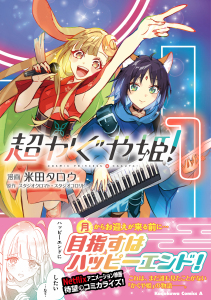
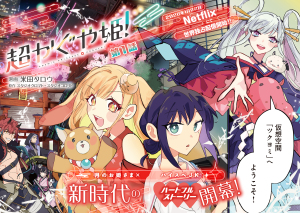
With both its Netflix release and theatrical run receiving widespread acclaim, Cosmic Princess Kaguya! has become a major topic of conversation.
Behind its production lay a creative “KASSEN,” where creators challenged and resonated with one another—much like the streamer of Tsukuyomi.
In this special feature, we present a behind-the-scenes conversation between director Shingo Yamashita and manga artist Taro Yoneda, who is responsible for the manga adaptation.
What sealed the deal: passion and love
How the manga adaptation began
—When the project first launched, what made you decide to ask Taro Yoneda to handle the manga adaptation?
Yamashita: The work includes quite a few action-driven sequences, so one thing I placed particular emphasis on was whether the movement could be depicted in a cool and compelling way. When I read Taro’s previous works, I remember being struck by the care put into male characters and action scenes. I’m personally very fond of Black Onyx, so I had high expectations that Taro would portray them in a very cool way.
Yoneda: I’m really happy to hear that. I genuinely enjoy drawing the series every time.
Yamashita: Another factor was that I wanted to create it from a rather female perspective. Since the work intentionally avoids overt sexual or romantic elements, I felt that a typical male-targeted style, where many female characters appear primarily as objects of attraction, might take it in a different direction. That was a significant factor as well.
Yoneda: I tend to aim for a refreshing tone that values love and bonds in a broad sense—friendship, family, romance, and more. Hearing that our creative style matched makes me very happy, and it also motivates me to do my best.
What manga can do—Mutual respect between creators
—What did you discuss in your initial meeting?
Yamashita: That was about a year ago—feels so long ago. I think I mentioned that since the story was created as a film, adapting it directly into manga might not be interesting. I told Taro that rewriting it freely was perfectly fine if it made the story more engaging.
Yoneda: I remember that clearly. I was surprised when you said that—even though anime can do so much, creators still feel there are things it can’t achieve. When you said, “There are scenes and episodes that only manga can include, so I want you to explore those,” I was thrilled.
Yamashita: I’ve probably read more manga than watched anime or films, so I often want to do “manga-like things” in animation. But there are limitations. For example, manga can include handwritten notes next to speech bubbles or commentary outside panels. Many anime directors probably wish they could do that, but in animation, explaining something requires dialogue or additional cuts, which increases runtime endlessly. Manga offers more control in that sense, so I remember asking Taro to use that strength to add subtle character details.
Yoneda: I love drawing battle action, but I’ve always envied how anime can show movement. So hearing the opposite from you was surprising.
Yamashita: Anime’s strength is the ability to present action alongside music and motion as a unified experience. Some people questioned whether the KASSEN scene was necessary, but without it, Kaguya’s departure wouldn’t feel as emotionally impactful. That scene naturally shows the friendship formed through action and the evolving relationship with Mikado, leading into the fireworks scene. Movement provides a persuasive power different from plot accumulation. That’s truly the strength of animation. In contrast, manga must build through dialogue and events, so the approach differs. I think we both understood these strengths and weaknesses.
The core of the characters
Supervision and restructuring
—Did you discuss character settings?
Yamashita: I recall Taro asking what kind of person Iroha is. Do you remember?
Yoneda: I do. When thinking about the overall structure, I wanted to understand the Sakayori family first.
Yamashita: That’s when I felt grateful we had Taro onboard. It was the first time someone asked those kinds of questions. Once animation production begins, staff discussions shift elsewhere, and we rarely revisit foundational settings. Taro’s perspective as an outsider gave us valuable insight—especially regarding the Sakayori family.
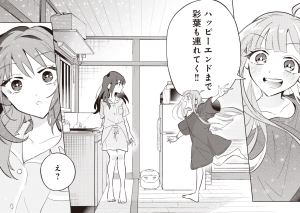
Yoneda: I remember you kindly answering many of the things I wanted to ask and discuss, including Iroha’s relationship with her mother and Yachiyo’s secret. The sense of realism found in those aspects is one of the work’s strengths, so I hope to preserve it while carefully considering how much of that essence to incorporate, and to continue moving forward through close consultation as the story develops.
—During production, what did you prioritize when supervising drafts and storyboards?
Yamashita: My main focus was ensuring characters remained consistent. In particular, I asked for adjustments to align with the backstory regarding Iroha and her mother, Momiji. Otherwise, Taro’s restructuring—such as timeline changes and scene cuts—was stylish and highly readable. I often found myself impressed by approaches we would never have conceived.
Yoneda: Manga relies heavily on dialogue. Unlike film or anime, readers won’t continue unless they choose to turn the page, so readability was my top priority. I frequently trimmed lines or adjusted phrasing. Director Yamashita often suggested revisions that better matched each character, saying things like, “this phrasing fits better,” which was extremely helpful and educational.
Memorable scenes and manga-specific touches
—Which scenes stood out to you?
Yamashita: The ending of Episode 3. When Kaguya starts streaming and Mikado discovers it—there’s a line like, “You seem happier than before, Iroha.” That scene isn’t in the anime, but I thought it was excellent. While I sometimes feel expressions like this might have been nice to include, in anime it’s generally not easy to add them without altering the structure of a scene. Seeing it in manga made me feel it was another valid interpretation. There are many such scenes.
Yoneda: Thank you. The editor and I discussed ending the chapter there. Initially, we included a close-up of Mikado’s eye, but the editor felt it was too suggestive, so we emphasized the word “Iroha” instead.
Yamashita: I didn’t know about that exchange.
Yoneda: When you reviewed the drafts, you often added comments like “This is great” or “I enjoyed reading this.” Those words meant a lot and always made me happy.
Yamashita: Positive feedback was important during anime production too. I worried that if good aspects weren’t acknowledged, they might be lost. Seeing others’ interpretations can reveal strengths you hadn’t noticed yourself.
—Following this process, the first collected volume of the manga adaptation was released on February 10. How do you feel looking back?
Yamashita: I was genuinely moved to see an original work reinterpreted through someone else’s perspective. This anime has a unique narrative structure unlike typical shonen manga, yet Taro’s reworking makes the adaptation read as a compelling manga. When I first read Chapter 1, the anime wasn’t finished yet, so it felt fresh.
Yoneda: I’m grateful that many people helped bring it together into a single volume—my first book. I experimented with techniques like introducing 3D models into the artwork, but looking back at earlier chapters from nearly a year ago, my past drawings feel a bit embarrassing (laughs).
—What manga-specific techniques do you focus on?
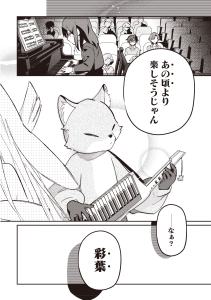
Yoneda: I try to create a highlight moment in every chapter. Considering readability on smartphones, I enlarge panels and speech bubbles to maintain a smooth tempo, while also expressing characters’ emotions through their hands and gestures. The face is of course the most important, but hands are the next most expressive feature, so I make a point of including them. For example, even in scenes where the anime has two characters talking across a desk from one another, I sometimes deliberately place them side by side within the same panel. I pay close attention to staging, or rather, to how the characters move and position themselves. And of course, I’m always conscious of trying to carry over the anime’s strong sense of pacing and the charm of the characters’ movements as directly as possible into the manga.
Yamashita: I’m learning a lot, truly. By the way, who’s your favorite character?
Yoneda: That’s a difficult question—I really love the whole cast. But if I had to pick just one, I’d say Otako the Loyal Dog. I like her mature, big-sister-type design and the way she plays a hype-building role, and she also feels like one of Kaguya and Iroha’s earliest fans.
Yamashita: Otako the Loyal Dog is a character with many background details. Even when Kaguya declares that she’s going to win, Otako’s expression alone is different.
Yoneda: Exactly— she has this reaction like, “That looks interesting,” in that moment. It’s a small cut, but I included it clearly in the manga.
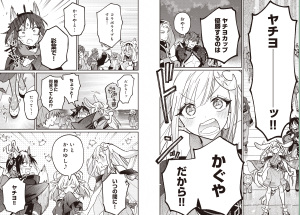
“The interesting guy” and supplementing everyday character moments
—Were there scenes you deliberately changed from the anime?
Yoneda: Mikado’s ago-kui (chin-lifting gesture) moment is a good example.
Yamashita: That scene (laughs). I thought Mikado would do something like that, so I passed it casually during supervision, but it carried intentional meaning for Taro.
Yoneda: In the anime, the KASSEN scene begins with a dramatic entrance—“Black Onyx has arrived!” as he bursts onto the scene.
Yamashita: And he’s riding a tiger bike (laughs). He’s the type who stages himself theatrically.
Yoneda: That’s why I see him as an “interesting guy” (laughs). However, manga page limits made reproducing that spectacle difficult, so I replaced it with a different depiction to emphasize his character. In my notes, I even wrote, “Is physical contact okay?” If it had been rejected, I considered alternatives like touching hair or simply placing a hand nearby. But Mikado is a showy, confident character, so I presented that as the first option.
Yamashita: Our interpretations aligned so well that I didn’t even feel it required direction. Of course Mikado would do ago-kui—especially in VR.
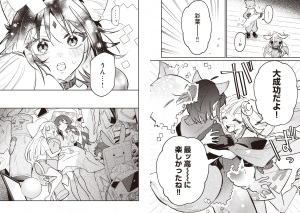
Yoneda: I’m relieved (laughs). Another major addition is Kaguya and Iroha’s live performance scene in Chapter 4, with comments flowing across the screen like Niconico streaming. Although not fully depicted in the anime, I believe it was a deeply memorable event for them. Afterward, there’s a panel showing them asleep together in a messy room—one of my favorites. I imagine Iroha, having given it her all that day, skipping her usual studying, falling asleep while scrolling her phone or chatting with Kaguya.
Yamashita: That everyday moment wasn’t shown in the main story, but they probably lived like that daily. Having those off-screen moments complemented so thoughtfully is incredibly gratifying as a director.
—How do you feel about Taro Yoneda’s newly drawn illustrations, such as the manga cover page and promotional artwork posted on X?
Yamashita: They’re fantastic! Taro has done so much in terms of promotion, and I’m really happy to see the reactions to announcements from the anime side as well. It was especially nice to see the positive response to the Yachiyo plush. I’m always grateful to see how deeply Taro is committed to the project through Taro’s posts on X.
Yoneda: I’m a big fan of the Yachiyo plush myself (laughs). I also love drawing fan art, so I’ve created quite a lot for Cosmic Princess Kaguya!—including many sketches I haven’t shared publicly. Honestly, I feel like drawing something whenever I get the chance!
Experience Cosmic Princess Kaguya! across every medium
—Finally, what do you hope readers gain from this adaptation?
Yoneda: Cosmic Princess Kaguya! is an epic anime film running nearly two and a half hours, and I feel one of its great strengths is how fully you can immerse yourself in it all at once. I hope the manga adaptation can serve as a kind of gateway—something people might casually pick up to get a sense of the series’ atmosphere. You can read Chapter 1 on a manga platform and continue at your own pace. Of course, you might also read through Volume 1 in one go, and if you find yourself wanting to know what happens next, I’d be happy if that led you to continue the story by watching the rest of it on Netflix. I also hope anime viewers enjoy spotting differences in the manga and exploring other media like music videos and novelizations. I created this adaptation hoping it becomes one piece of a multi-faceted experience. I’d be delighted if readers revisit both the anime and my work repeatedly.
Yamashita: The film, manga, and novelization follow the story while showcasing strengths unique to each medium. Experiencing multiple formats enhances the “resolution” of the work—offering many ways to deepen understanding. I hope audiences immerse themselves repeatedly, taking advantage of streaming’s accessibility. Please enjoy the story in every form—immerse yourself fully in Cosmic Princess Kaguya!
▼The manga adaptation of Cosmic Princess Kaguya! is now serialized on Kadocomi!
https://comic-walker.com/detail/KC_008281_S?episodeType=first
▼Volume 1 of the manga adaptation of Cosmic Princess Kaguya! is now on sale to great acclaim!
https://www.kadokawa.co.jp/product/322509000193/